Role
Designer
Developer
Team
Myself
Timeline
6 Months
Tools
Figma
Unreal Engine
Overview
A multi-sensory experience system for relaxation and treatment.
Residents of assisted living and palliative care patients struggle with a lack of independence, having to rely on their caretakers to assist them. Something as simple as a hand rail to hold onto is huge for providing them with independence.
I saw an opportunity to use technology to bridge the gap. Drawing on the practice of forest bathing, I designed a multi-sensory experience system to enable patients to benefit from nature's influence on the body in the comfort of their own home or hospice, while preserving their independence.
Context & Problem
Patients often lose independence and spend long periods waiting for caregiver availability.
Ontario’s long term care is struggling with the demand outpacing capacity, being severely understaffed and historically underfunded. For patients and residents who may rely on caregivers this can lead to a lot of downtime and waiting.
Research
Understanding Elder Care: Insights from Sheridan’s Elder Research Centre & Secondary Research
I met with the head of Sheridan’s centre for elder research and consumed secondary research to get an understanding of the challenges patients face and the technical research or testing that’s currently used in the field.
Patients admitted they could no longer travel due to health complications, insurance or financial restrictions, companion concerns or mobility issues. (Fiocco et al.)
Primary challenges for long-term and palliative care patients consist of pain, depression, difficulty coping, a loss of dignity, and lack of independence. (Woo et al.)
VR studies have shown to alleviate pain when used individually or alongside traditional methods in the treatment of traumatic experiences.
VR therapy showed reductions in pain, fatigue, depression, anxiety, and improved well-being.
Additional Research
Nature provides innate, science-backed benefits to the body.
My secondary research led me to forest bathing (shinrin-yoku), a Japanese therapeutic practice centred on mindful immersion in natural environments. Studies on the practice show it lowers stress hormones, reduces blood pressure, and boosts immune function, even short doses of outdoor exposure dramatically improve sleep quality, sharpen cognitive focus, and ease tension.
Goals
Drawing on early research into palliative care and VR-based interventions in healthcare, I defined three goals:
How Might We
Competitive Analysis
Where today’s solutions fall short on comfort and control.

Personas
Understanding who we're designing for: Palliative care isn't just for the elderly.


Journey Map
Maintaining independence through the care journey.

Pivotal Moment
Don’t bring them to the environment, bring the environment to them.
I initially struggled with how to approach the problem and it wasn’t till after my first iteration that I realized I was looking at the solution backwards. Why create a location to attend like some school field trip (which would create an entirely different set of mobility and risk issues), I should be trying to bring the solution into their homes.
Early Prototypes
Pivoting to a virtual reality solution.
When I was first testing the idea a number of participants made reference to a specific place or memory that was special to them. It gave me the idea to use 360 degree videos of real locations, with the business opportunity to capture the unique real world places they hold dear.

Testing and Refining
Testing and refining from feedback
I tested my prototypes with four different participants, concluding each session with a semi-structured interview to test any assumptions I had made beforehand. These quotes had the biggest impact on the project:
Since there was a strong desire to involve more of the senses I understood that they were very valuable to the experience so I designed additional physical components to accommodate this desire.
While everyone has unique memories, by using familiar environments it helped users connect with them.
People value their time (and have short attention spans) for this reason I took consideration to minimize the setup time and maximize their experience time.
Final Design
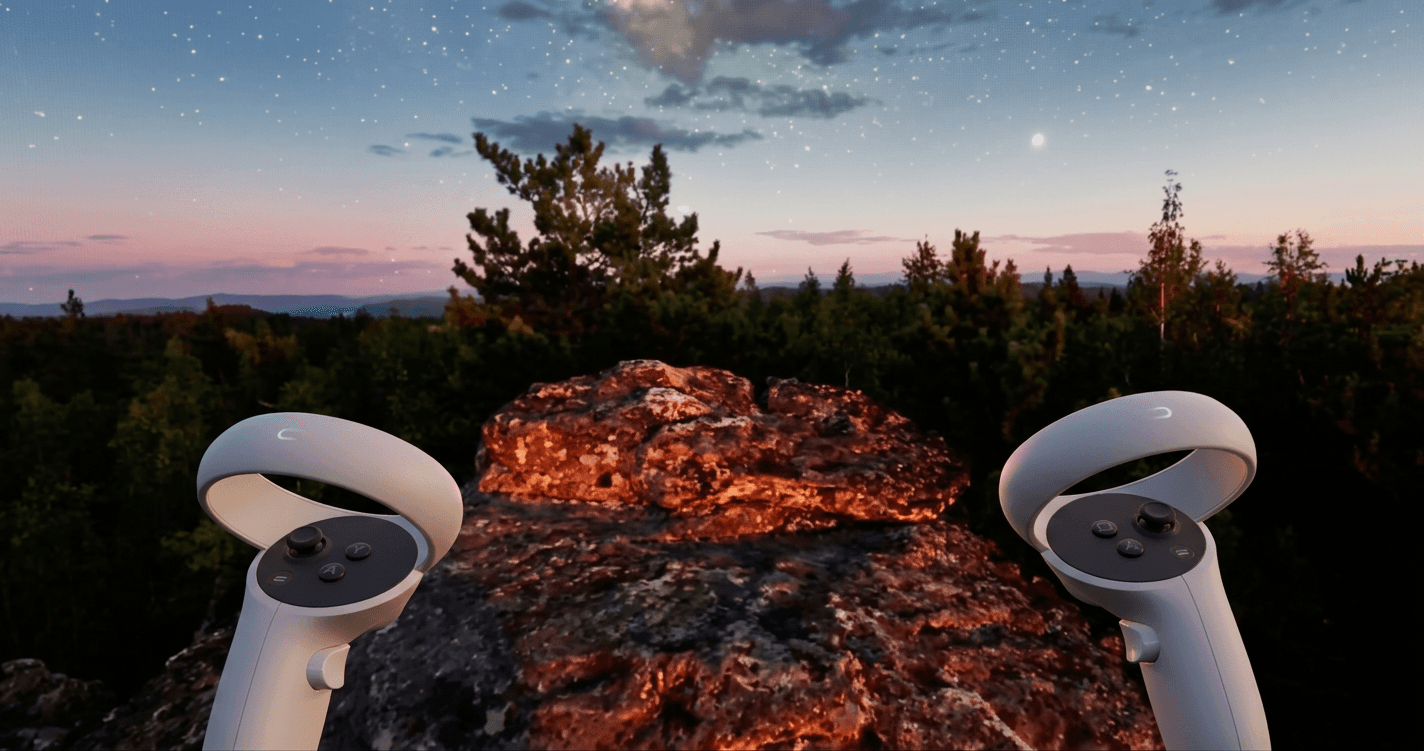
Experience calmness from a new perspective
Visit that family college, favourite beach trip, or somewhere you've never been. Capture that moment and visit it anytime you like.
Final Design
Bringing all five senses into care with a calming multi sensory kit
To create a truly immersive experience, I designed a multi-sensory kit with an individual artifact to address each of our five senses. You're not just seeing the environment, you're smelling it and feeling it too.

Reflection
Find a personal connection in the problem you're solving.
The best motivation to solve a problem is to find a personal connection to it. Your solutions will be more meaningful and you’ll have a deeper sense of empathy for those you are solving for. If you lack a personal connection your solutions can feel empty and lack any real substance.
If I revisited this project, I'd want to test the multi-sensory kit with real physical prototypes rather than a 3D rendering, since the emotional impact of scent and texture is hard to validate without something tangible in someone's hands.